

Patent DE 10 2016 113 283
Method for determining a resistance deflection of a Wheatstone bridge in a high temperature environment
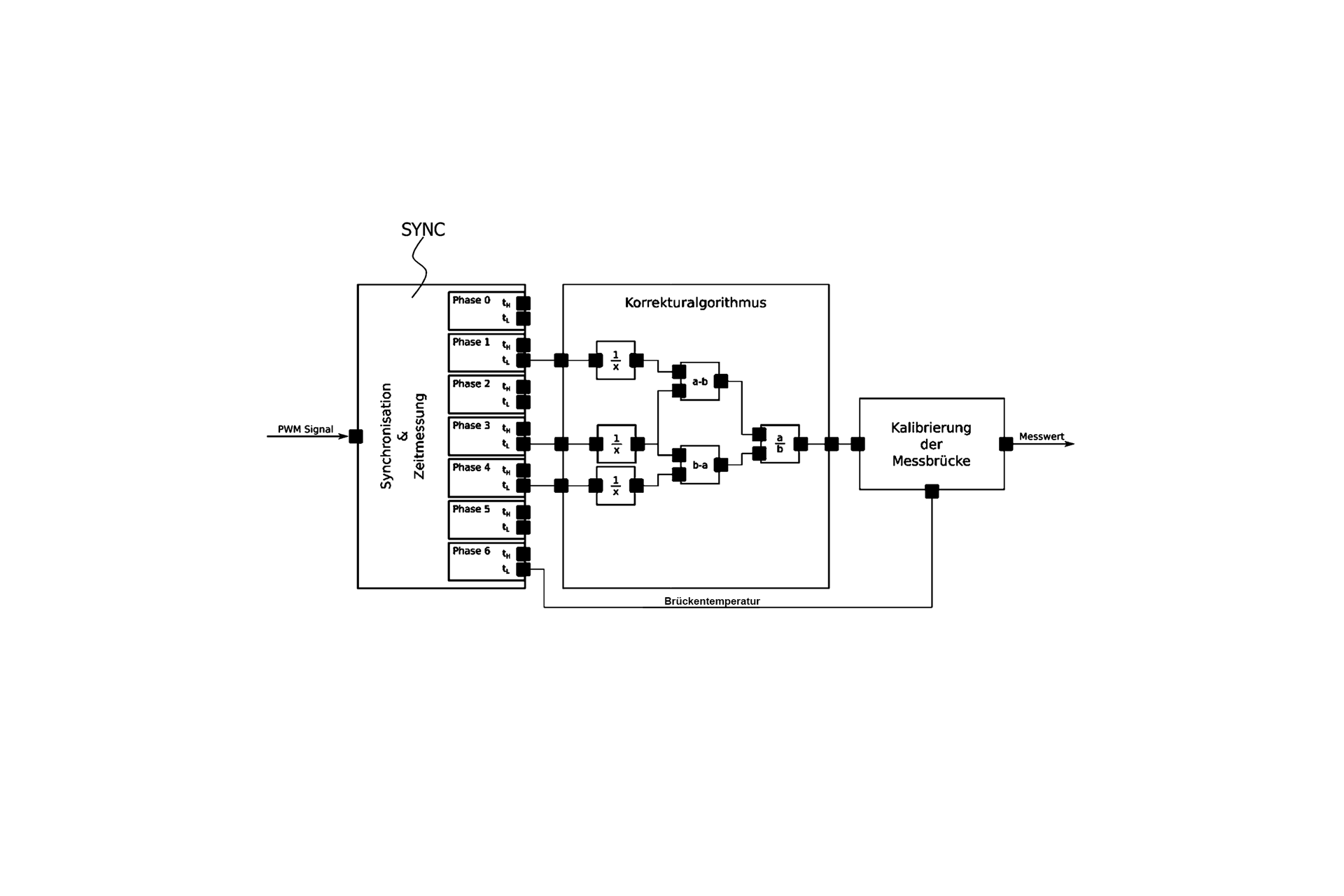
The invention relates to a method for determining a resistance deflection of a Wheatstone bridge in a high-temperature environment, wherein the output voltage derived from the Wheatstone bridge is transferred as an input voltage signal (VIN) to an ASIC signal path and is converted into a current signal in a first step, wherein the current signal is converted into a time signal in a second step and the time signal is then converted into a pulse width modulated signal (PWM), wherein the value of a relative resistance deflection (∆R/R) of the Wheatstone bridge is determined from the time lengths within the phase sequence of the pulse width modulated signal.
Patent No.:DE 10 2016 113 283
Inventor:Georg Gläser. Dagmar Kirsten. Dirk Nuernbergk. André Richter
Application:
HochtemperatursensorikResearch field:Integrated sensor systems
granted patent
Application date:19 July 2016
Date of first publication:15 January 2018
Date of publication of grant:30 April 2026
Related content

Project
HoTSens
Integrated sensors and microelectronics operate at 300°C, enabling more efficient processes


Modulare Hochtemperatur-Testplattform bis 300 °C
Björn Bieske1, Tom Reinhold1, Marco Reinhard130. GI/GMM/ITG-Workshop, Testmethoden und Zuverlässigkeit von Schaltungen und Systemen (TuZ 2018), , Freiburg im Breisgau, Germany1IMMS Institut für Mikroelekronik- und Mechatronik-Systeme gemeinnützige GmbH (IMMS GmbH), Ehrenbergstraße 27, 98693 Ilmenau, GermanyHigh-Precision Mixed-Signal Sensor Interface for a Wide Temperature Range [0° – 300°C]
Georg Gläser1, Dagmar Kirsten2, André Richter1, Marco Reinhard1, Gerrit Kropp1, Dirk M. Nuernbergk3in Journal of Microelectronics and Electronic Packaging, vol. 15, no. 1, pp. 1-8, 2018, DOI: doi.org/10.4071/imaps.5238471IMMS Institut für Mikroelekronik- und Mechatronik-Systeme gemeinnützige GmbH (IMMS GmbH), Ehrenbergstraße 27, 98693 Ilmenau, Germany, 2X-FAB Semiconductor Foundries GmbH, Haarbergstraße 67, 99097 Erfurt, Germany, 3Melexis GmbH, Konrad-Zuse-Straße 15, 99099 Erfurt, GermanyHigh-Precision Mixed-Signal Sensor Interface for a Wide Temperature - Range [0°-300°C]
Georg Gläser1, Dirk M. Nuernbergk2, Dagmar Kirsten3, André Richter1, Marco Reinhard1, Gerrit Kropp1International Conference and Exhibition on High Temperature Electronics Network, HiTen 2017, , Queens College, Cambridge, UK1IMMS Institut für Mikroelekronik- und Mechatronik-Systeme gemeinnützige GmbH (IMMS GmbH), Ehrenbergstraße 27, 98693 Ilmenau, Germany, 2Melexis GmbH, Konrad-Zuse-Straße 15, 99099 Erfurt, Germany, 3X-FAB Semiconductor Foundries AG, Haarbergstraße 67, 99097 Erfurt, GermanyDesign and characterization of a high-temperature pressure measurement system
Georg Gläser1Workshop on High Temperature Electronics, , Duisburg1IMMS Institut für Mikroelekronik- und Mechatronik-Systeme gemeinnützige GmbH (IMMS GmbH), Ehrenbergstraße 27, 98693 Ilmenau, Germany
Event,
TuZ 2018

Event,
Long Night of the Sciences
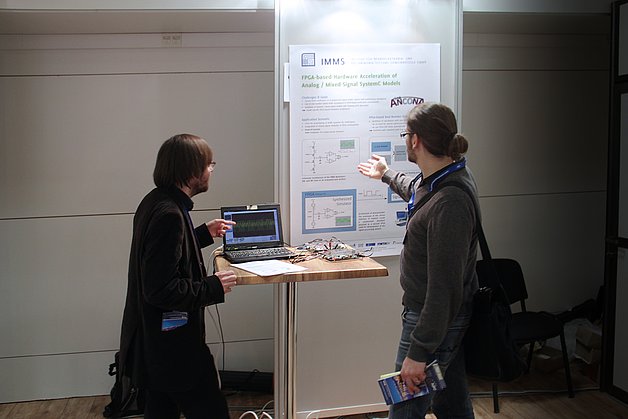
Discover interactive demonstrators, lectures on chip design and test setups.
Event,
HiTEN 2017
Lecture
High-Precision Mixed-Signal Sensor Interface for a Wide Temperature - Range [0°-300°C]
Georg Gläser1, Dirk M. Nuernbergk2, Dagmar Kirsten3, André Richter1, Marco Reinhard1, Gerrit Kropp1
1IMMS Institut für Mikroelekronik- und Mechatronik-Systeme gemeinnützige GmbH
2Melexis GmbH, Erfurt
3X-FAB Semiconductor Foundries AG, Germany, Erfurt
Event,
TuZ 2016
Two presentations at the 28th GMM/GI/ITG Workshop on test methods and reliability of circuits
Contact
Contact
Eric Schäfer, M. Sc.
Head of Microelectronics and Branch Office Erfurt, Authorised Signatory
eric.schaefer(at)imms.de+49 (0) 361 663 25 35
Eric Schäfer and his team research Integrated sensor systems, especially CMOS-based biosensors, ULP sensor systems and AI-based design and test automation. The results are being incorporated into research on the lead applications Sensor systems for in-vitro diagnostics and RFID sensor technology. It will assist you with services for the development of Integrated circuits and with IC design methods.
This might also be interesting for you
Research field
Integrated sensor systems
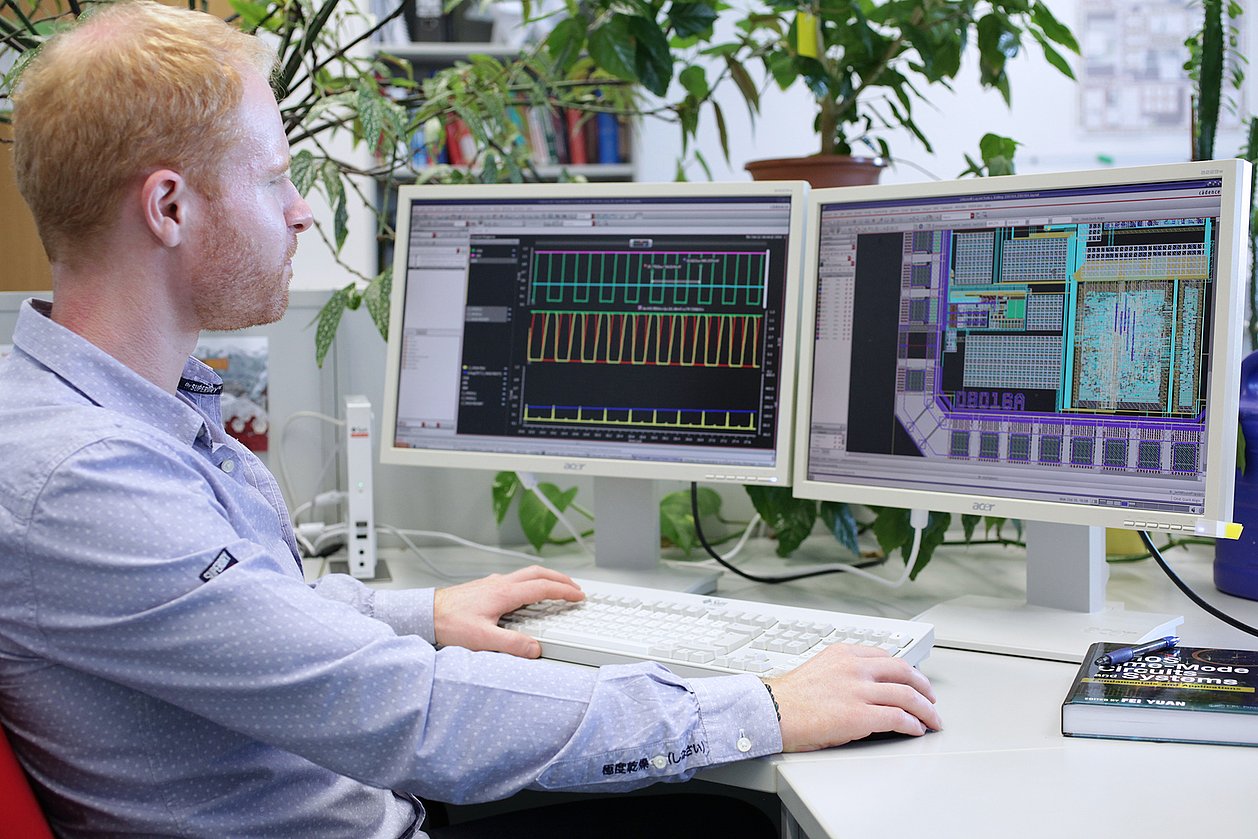
Here we investigate miniaturised systems manufactured in semiconductor technology consisting of microelectronic components for sensors applications, as well as methods to design these highly complex systems efficiently and safely.