

Patent DE 10 2024 138 869
Device, image sensor and method for analysing samples using time-resolved fluorescence measurement
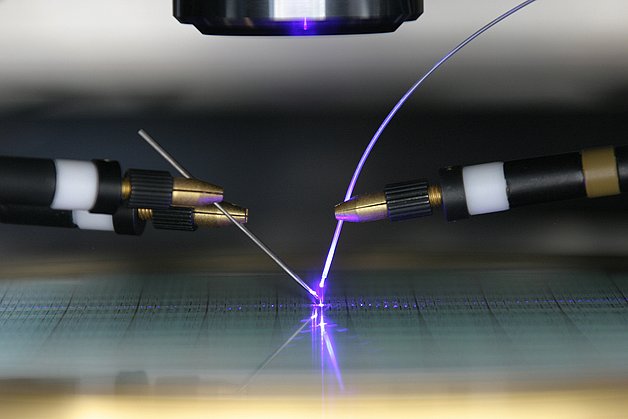
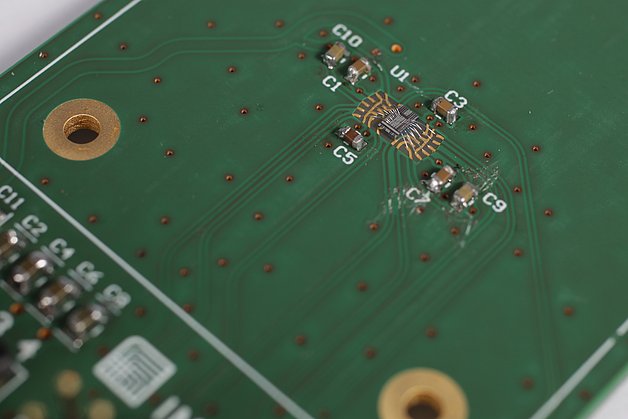
High-precision medical diagnostic systems are large and expensive, they are primarily used in centralised laboratories and involve waiting times and travel times of several days. However, where rapid test results are essential or investment in a laboratory is not feasible, as, for example, in countries of the Global South, point-of-care (PoC) tests are an option. To this end, the IMMS is developing CMOS-based biosensors that enable structural dimensions in the µm range to be realised, thereby allowing properties to be measured at the molecular scale. A novel SPAD-based sensor for the time-resolved readout of fluorescence-labelled DNA microarrays contributes to more precise PoC measurements.
In the field of medical diagnostics (in vitro diagnostics), the concentration of analytes such as proteins or DNA can be determined using time-resolved fluorescence measurement. To test different analytes simultaneously, so-called microarrays with individual test spots are used. During the measurements, the microarrays are usually illuminated by a laser, which excites an added fluorescent dye to emit light depending on the concentration of an analyte. The concentration of an analyte can be determined from the ratio of excitation light to fluorescence light.
Single-photon avalanche diodes (SPADs) are suitable for measuring the fluorescence light; these allow individual photons to be detected with high temporal resolution (time-correlated single-photon counting, TCSPC). An SPAD arrangement comprising one or more SPADs corresponds to a test spot.
The excitation light is not distributed homogeneously across the entire microarray. However, the intensity of the excitation light must be known at every position on the microarray in order to enable the determination of the molar concentration of an analyte. Due to the properties of the excitation light, SPADs are not suitable for measuring it. Consequently, in the current state of the art, the excitation light is homogenised using complex and costly optical systems.
The concept behind the invention is a cost-effective solution that dispenses with homogenisation and involves placing additional photodiodes between the individual SPAD arrays in order to determine the intensity of the excitation light. Through normalisation and interpolation, the light can be calculated precisely for each test spot. This enables targeted correction of inhomogeneity, and a large number of test spots on a given microarray can be examined and analysed accurately at the same time.
Advantages of the invention
- Elimination of complex and costly homogenisation optics
- Targeted correction of the inhomogeneity of the excitation light through its precise calculation for each test spot
- High-precision PoC measurements to determine the concentration of, for example, DNA or proteins

Patent No.:DE 10 2024 138 869
Inventor:Benjamin Saft. Maximilian Wiener. Eric Schäfer
Application:
Biosensors for medical diagnostics using fluorescence measurementResearch field:Integrated sensor systems
granted patent
Application date:19 December 2024
Date of first publication:25 June 2026
Date of publication of grant:01 October 2026
Related content
Project
FluoResYst
The IMMS is developing a SPAD-based sensor for time-resolved readout of fluorescence-labelled DNA microarrays.

Press release,
Silicon Science Award geht an Nachwuchsforscher von IMMS und TU Ilmenau
Arbeit zu zeitkorrelierter Einzelphotonenzählung für Messungen im Pikosekundenbereich ausgezeichnet

Press release,
Rapid detection system for multi-resistances in tuberculosis infections
Eight partners from research and industry launch BMBF FluoResYst project
Integrated SPAD-Based Entropy Source Using an On-Chip Trigger Diode for QRNG (Quantum Random Number Generator)
Benjamin Saft1, Alexander Zimmer2, Jakob Hampel1, Daniel Gäbler2, Maximilian Wiener1, Eric Schäfer1The International SPAD Sensor Workshop (ISSW), , Yonsei University, Seoul, South Korea1IMMS Institut für Mikroelekronik- und Mechatronik-Systeme gemeinnützige GmbH (IMMS GmbH), Ehrenbergstraße 27, 98693 Ilmenau, Germany, 2X-FAB Global Services GmbH, Haarbergstraße 67, 99097 Erfurt, GermanyVery steep LED light pulses: a selection-guideline
Vincent Haude1, Alexander Rolapp1, Michael Meister12026 IEEE 23rd International Multi-Conference on Systems, Signals & Devices (SSD), , Catania, Italy, pp. 382-387, DOI: doi.org/10.1109/SSD69655.2026.115590571IMMS Institut für Mikroelekronik- und Mechatronik-Systeme gemeinnützige GmbH (IMMS GmbH), Ehrenbergstraße 27, 98693 Ilmenau, Germany
Contact

Contact
Eric Schäfer, M. Sc.
Head of Microelectronics and Branch Office Erfurt, Authorised Signatory
eric.schaefer(at)imms.de+49 (0) 361 663 25 35
Eric Schäfer and his team research Integrated sensor systems, especially CMOS-based biosensors, ULP sensor systems and AI-based design and test automation. The results are being incorporated into research on the lead applications Sensor systems for in-vitro diagnostics and RFID sensor technology. It will assist you with services for the development of Integrated circuits and with IC design methods.
This might also be interesting for you
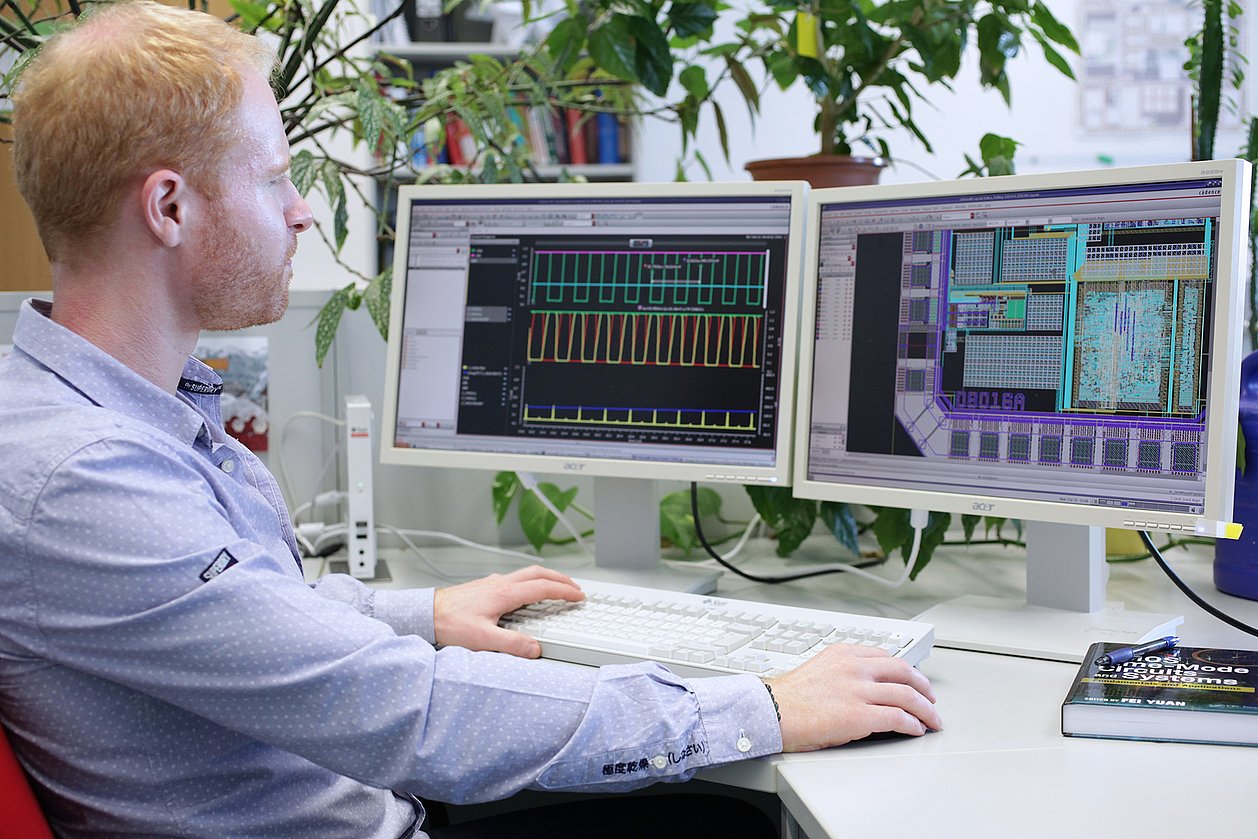
Research field
Integrated sensor systems
Here we investigate miniaturised systems manufactured in semiconductor technology consisting of microelectronic components for sensors applications, as well as methods to design these highly complex systems efficiently and safely.
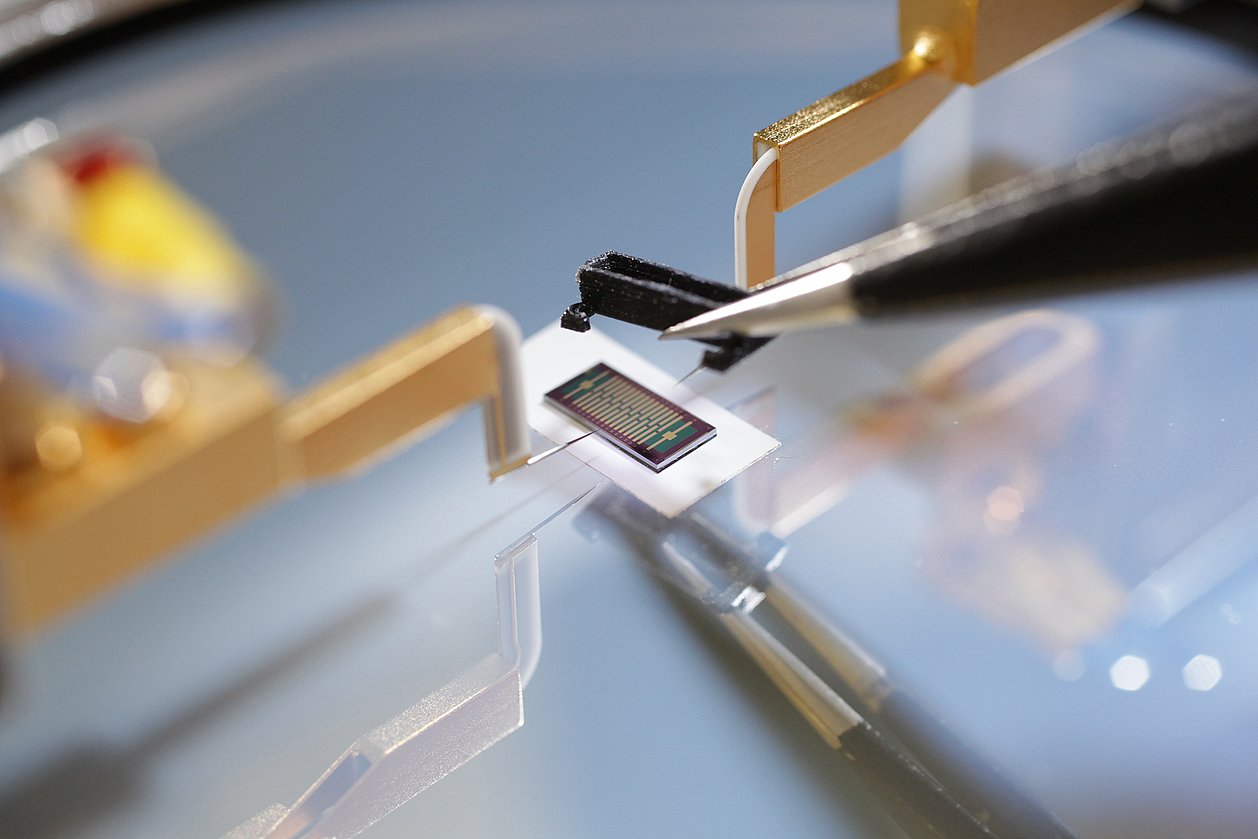
Lead application
Sensor systems for in-vitro diagnostics
Here we are developing sensor systems for in-vitro diagnostics that enable individual, decentralised health monitoring for all with electronic rapid tests.