

Patent DE 10 2013 113 378
Method and electronic circuit for determining the time instant of an extremum of a time-varying capacitance
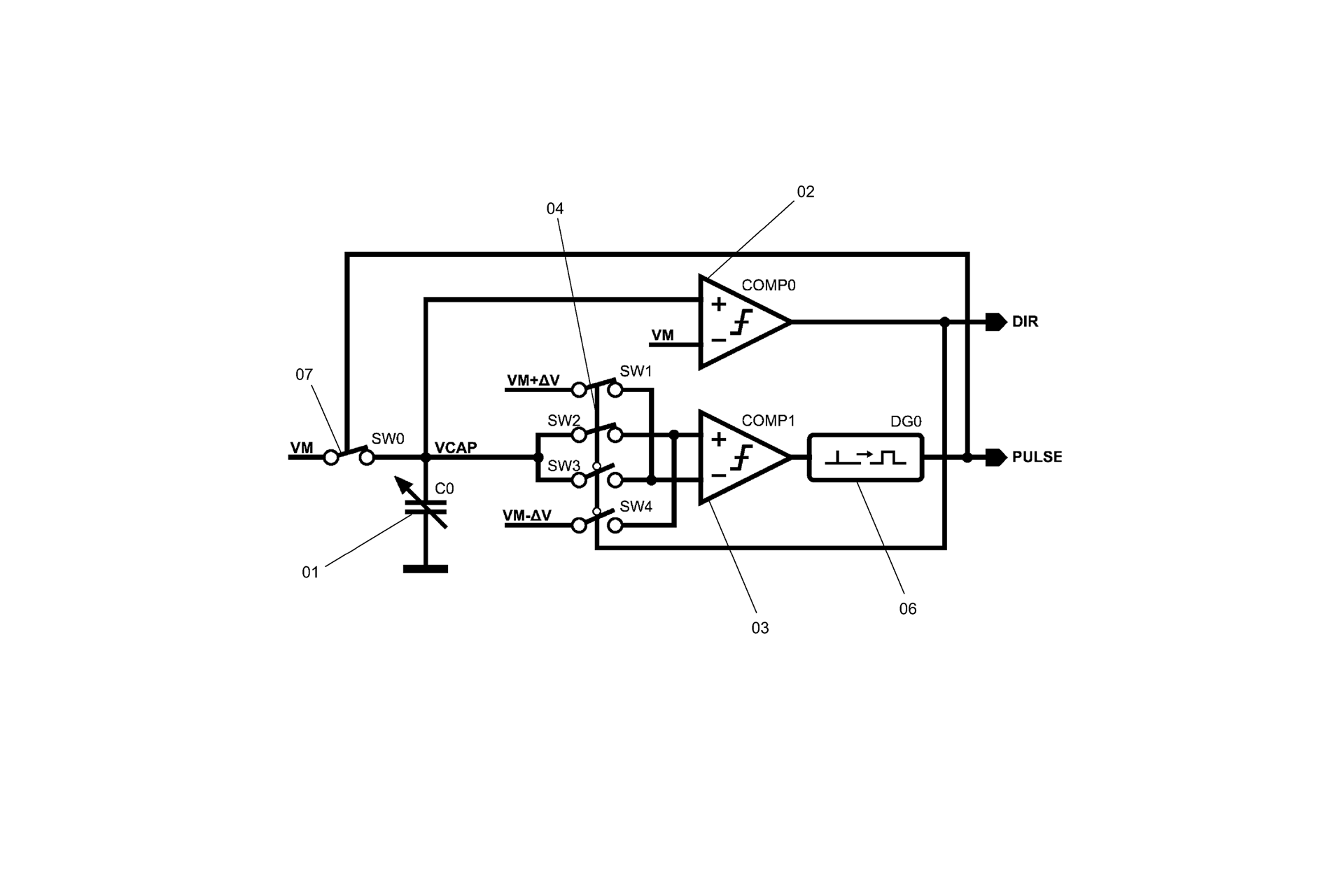
Method for determining the time instant of an extremum of a time-varying capacitance of a capacitor (01), comprising the following steps:
- comparing a voltage (VCAP) applied to the capacitor (01) with a lower voltage value (VM - ΔV) and an upper voltage value (VM + ΔV);
- recharging the capacitor (01) to an average voltage value (VM) that lies between the lower voltage value (VM - ΔV) and the upper voltage value (VM + ΔV) if the voltage (VCAP) applied to the capacitor (01) is less than the lower voltage value (VM - ΔV) or greater than the upper voltage value (VM + ΔV);
- repeat the recharging of the capacitor (01) if the voltage (VCAP) applied to the capacitor (01) is again less than the lower voltage value (VM - ΔV) or again greater than the upper voltage value (VM + ΔV);
- determining a reference time at which the voltage (VCAP) applied to the capacitor (01) passes through the mean voltage value (VM);
- and determining the time instant of the extremum as a function of the determined reference time.
Patent No.:DE 10 2013 113 378
Inventor:Benjamin Saft. Eric Schäfer
Application:
Front-end circuit for electrostatic energy harvesters| capacitive position detectionResearch field:Integrated sensor systems
granted patent
Application date:03 December 2013
Date of first publication:03 June 2015
Date of publication of grant:26 January 2017
Related content

Award
Silbermedaille für Erfindung / Neuheit: Elektronische Verzögerungsschaltung in CMOS-Technologie
André Jäger
Project
GreenSense
For bio-analysis IMMS developed energy-efficient multi-parametric RFID microsensors and energy harvesting modules for operating autonomous sensors.
Press release,
Highly accurate and battery-free measurement via RFID
IMMS PhD candidate defends dissertation on precise passive RFID sensor technology

Press release,
IMMS receives iENA silver medal for energy-efficient solutions in integrated circuits
Approach to be used in energy-efficient biological analysis and Industry 4.0 applications.
Press release,
IMMS receives Best Paper Award for MEMS Energy Harvesting Module
Ilmenau, 22.09.2014. On Friday at the ANALOG 2014 conference in Hannover, Germany, IMMS researchers received the Best Paper Award for their article and lecture "A System Architecture for an Integrated Electrostatic MEMS Energy Harvesting Module". This work on the development of miniaturized energy harvesters will establish innovative supply options for self-powered wireless microsensor networks.
The presented topic was part of the the GreenSense research project which started in 2012.…

Press release,
IMMS Receives Best Paper Award For Work On Energy-Efficient Sensor
The CMOS temperature sensor was presented at the APCCAS 2014 and is designed for energy-autonomous sensor systems with power supply from MEMS energy harvesting modules.
Adaptiver Frontend-ASIC für elektrostatische Energy-Harvester
Benjamin Saft1, Eric Schäfer1, André Jäger1, Alexander Rolapp1, Eckhard Hennig28. GMM-Workshop „Energieautarke Sensorik“, , Renningen (Robert Bosch GmbH), Germany1IMMS Institut für Mikroelekronik- und Mechatronik-Systeme gemeinnützige GmbH (IMMS GmbH), Ehrenbergstraße 27, 98693 Ilmenau, Germany, 2Reutlingen University, Alteburgstraße 150, 72762 Reutlingen, GermanyAn Ultra-Low Power Capacitance Extrema and Ratio Detector for Electrostatic Energy Harvesters
Benjamin Saft1, Eric Schäfer1, Alexander Rolapp1, Eckhard Hennig2ESSCIRC Conference 2015 - 41st European Solid-State Circuits Conference (ESSCIRC), , Graz, Austria, pp. 245-248, DOI: dx.doi.org/10.1109/ESSCIRC.2015.73138731IMMS Institut für Mikroelekronik- und Mechatronik-Systeme gemeinnützige GmbH (IMMS GmbH), Ehrenbergstraße 27, 98693 Ilmenau, Germany, 2Reutlingen University, Alteburgstraße 150, 72762 Reutlingen, GermanyVibration energy generators for low-frequency spectral excitations
Bianca Leistritz1,2, Michael Katzschmann2, Hannes Toepfer1,2in Procedia Engineering, EUROSENSORS 2014, the 28th European Conference on Solid-State Transducers, vol. 87, pp. 420–423, 2014, DOI: dx.doi.org/10.1016/j.proeng.2014.11.2831Technische Universität Ilmenau, Institute for Information Technology, 98684 Ilmenau, P.O. Box 10 05 65, Germany, 2IMMS Institut für Mikroelekronik- und Mechatronik-Systeme gemeinnützige GmbH (IMMS GmbH), Ehrenbergstraße 27, 98693 Ilmenau, GermanyA Low-Voltage Low-Power CMOS Time-Domain Temperature Sensor Accurate To Within [-0.1,+0.5]˚C From -40˚C To 125˚C
Jun Tan1, Alexander Rolapp1, Eckhard Hennig12014 IEEE Asia Pacific Conference on Circuits and Systems (APCCAS), , Ishigaki, Japan, pp. 463–466, DOI: doi.org/10.1109/APCCAS.2014.70328191IMMS Institut für Mikroelekronik- und Mechatronik-Systeme gemeinnützige GmbH (IMMS GmbH), Ehrenbergstraße 27, 98693 Ilmenau, Germany
Contact

Contact
Eric Schäfer, M. Sc.
Head of Microelectronics and Branch Office Erfurt, Authorised Signatory
eric.schaefer(at)imms.de+49 (0) 361 663 25 35
Eric Schäfer and his team research Integrated sensor systems, especially CMOS-based biosensors, ULP sensor systems and AI-based design and test automation. The results are being incorporated into research on the lead applications Sensor systems for in-vitro diagnostics and RFID sensor technology. It will assist you with services for the development of Integrated circuits and with IC design methods.

Contact
Dr.-Ing. Ludwig Herzog
Head of Mechatronics
ludwig.herzog(at)imms.de+49 (0) 3677 874 93 60
Dr. Ludwig Herzog will provide detail on our research on magnetic 6D direct drives with nm precision for the nm measurement and structuring of objects. He supports you with services for the development of mechatronic systems, for simulation, design and test of MEMS as well as for finite element modelling (FEM) and simulation.
This might also be interesting for you
Research field
Integrated sensor systems
Here we investigate miniaturised systems manufactured in semiconductor technology consisting of microelectronic components for sensors applications, as well as methods to design these highly complex systems efficiently and safely.