

GeMiC 2015 in Nürnberg
Description:
Lecture, Wednesday, March 18, 2015, 09:15, SP4.4: Modeling of BAW filters for system level simulation
Dominik Karolewski1, Andreas Tag2, Victor Silva Cortes3, Christoph Schäffel1, Amelie Hagelauer2, Georg Fischer2
1Institut für Mikroelektronik- und Mechatronik-Systeme GmbH, Germany; 2University of Erlangen-Nuremberg, Germany; 3Friedrich-Alexander-Universität Erlangen-Nürnberg, Germany
Abstract:
A behavioral model of a BAW resonator realized in VerilogA is presented. VerilogA models can be integrated in all leading RF design tools allowing simulations of BAW filters at a system and circuit level. In that way a coupled design of the conventional electronics and the electro-mechanical BAW is now possible. By using the presented model the system designer has the possibility to optimize both the conventional electronic and BAW components according to the system requirements simultaneously. The VerilogA model has been verified by performing optimization in Cadence and ADS.
Lecture, Wednesday, March 18, 2015, 09:30, SP4.5: Electrostatic parallel-plate MEMS Switch on Silicon-Ceramic-Composite-Substrates
Sebastian Gropp1, Michael Fischer1, Martin Hoffmann2, Jens Müller1, Astrid Frank3, Christoph Schäffel4
1Ilmenau University of Technology, Germany; 2Technische Universität Ilmenau, Germany; 3IMMS Institut für Mikroelektronik- und Mechatronik-Systeme Gemeinnuetzige GmbH, Germany; 4Institut für Mikroelektronik- und Mechatronik-Systeme GmbH, Germany
Abstract:
In this work we will present the capabilities of this monolithic SiCer (silicon on ceramics) [1] compound by producing a parallel-plate RF-MEMS switch with flexible electrodes and integrated coplanar waveguides. The series switch is one part of a LTE demonstrator and is developed in a heterogeneous process design. Here, the aim is to create a low-voltage switch for mobile use with a simple layout. The modelling and simulation of the parallel-plate switch with flexible electrodes is carried out using ANSYS (electro-mechanical simulation) and CADENCE (circuit simulation). To demonstrate the advantages of the composite substrate, the coplanar waveguides for the RF-signal and the control lines for the actuation of the electrostatic parallel plates of the switch are processed by screen printing them on the LTCC tapes before sintering the composite. The relocation of the waveguides into the LTCC avoids damping influences on RF signals by the silicon. An optimal process flowchart for modifying the silicon surface is shown through which bond areas with a homogeneous bond strength between silicon and LTCC are achieved and certain areas with cavities at the bond interface can be produced.
Contact
Contact
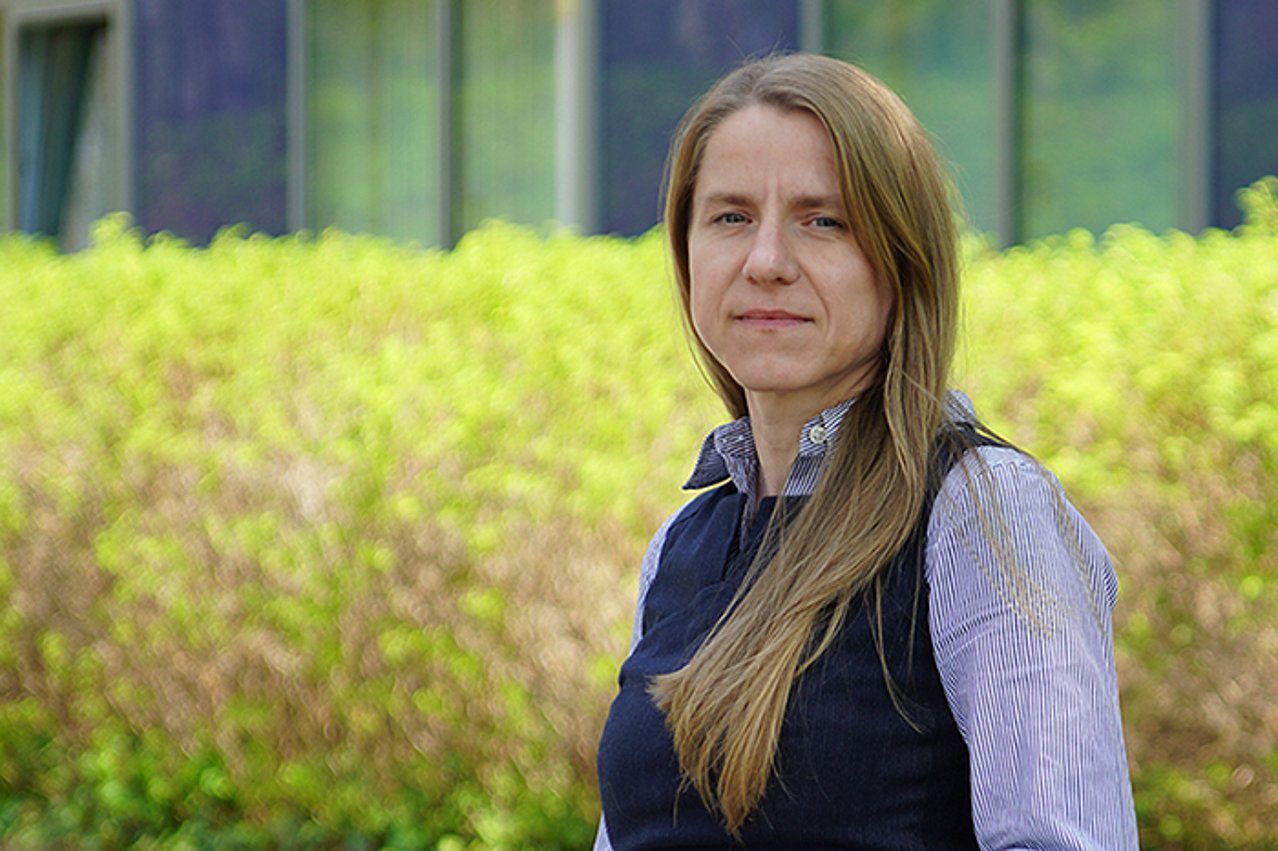
Dipl.-Hdl. Dipl.-Des. Beate Hövelmans
Head of Corporate Communications
beate.hoevelmans(at)imms.de+49 (0) 3677 874 93 13
Beate Hövelmans is responsible for the text and image editorial work on this website, for the social media presence of IMMS on LinkedIn and YouTube, the annual reports, for press and media relations with regional and specialist media and other communication formats. She provides texts, photographs and video material for your reporting on IMMS, arranges contacts for interviews and is the contact person for events.