

Project PlanarMikroFab
Highly dynamic, lightweight drive system for micro-manufacturing
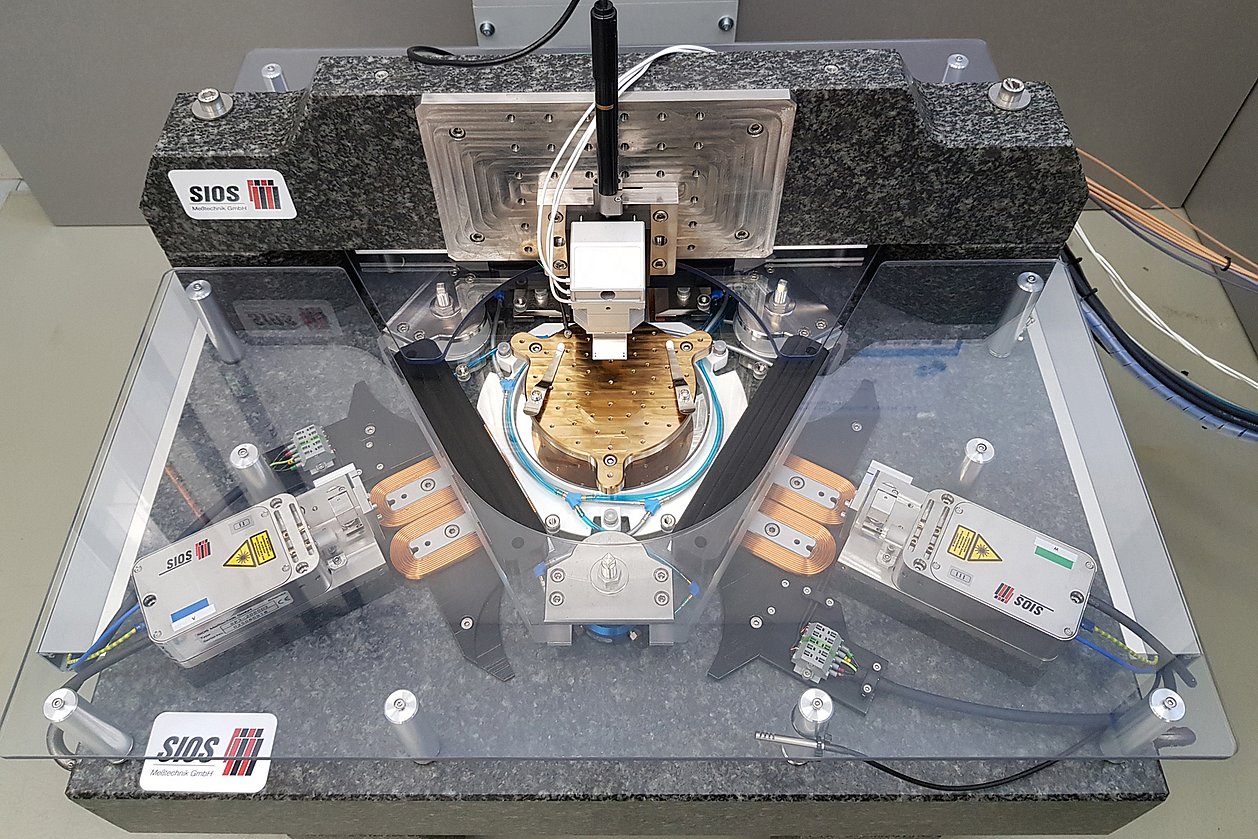
The project involves the development of a new drive system featuring a lightweight, optimised XY flat stage with integrated sensors, based on a planar direct drive. The new drive system will enable highly dynamic movements for the production of extremely complex microstructures to a consistently high standard of quality, whilst making the process more cost-effective.
Applications such as the manufacture of microlens arrays for photonics, medical technology, semiconductors and photovoltaics will benefit from this.
Greater dynamics for microfabrication, greater pressure on SMEs
Modern optical components with free-form surfaces and integrated microstructures require not only excellent surface quality with nanometre precision but also the highest degree of dimensional accuracy. As geometric complexity increases, established ultra-precision machine tools are reaching their limits: if the performance of single-crystal diamond tools is to be fully utilised at the finest resolution, nanometre-level precision in motion control is required, coupled with the highest possible dynamics. At present, the large moving masses, vibrations caused by drive and reaction forces, and thermal deformations significantly limit the feed dynamics that can be achieved in practice, even though the tools used could theoretically perform much better.
The rising demand for customised, high-precision components is putting increasing pressure on companies to continue producing economically whilst maintaining high quality. This applies in particular to the fast-growing key sector of photonics, which in Europe is predominantly characterised by small and medium-sized enterprises (SMEs). Many of these SMEs are highly specialised in certain disciplines. However, an in-depth examination of the innovations required for novel control and drive technology exceeds their capabilities.
The PlanarMikroFab project therefore aims to enhance the competitiveness of such SMEs in terms of quality, yield, cycle time and series production costs, as well as to create scope for offering more complex free-form microstructures cost-effectively, in line with the growing photonics market.
Planar direct drive with carbon slider – less mass, greater precision
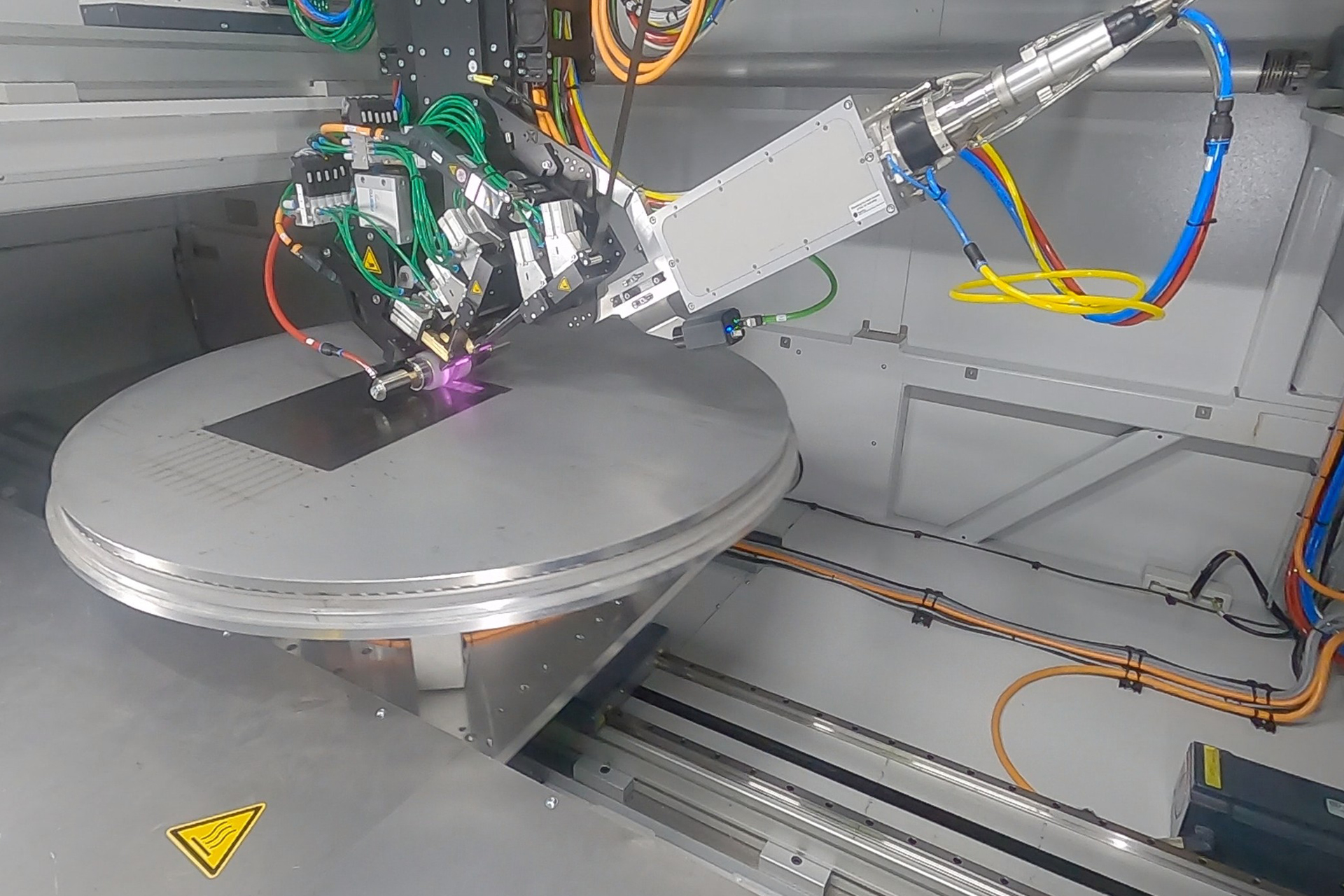
Instead of the conventional serial axis configuration, the project utilises a planar direct drive developed at the IMMS, in which the actuator forces are transmitted in parallel and directly to a single, frictionlessly guided component – the slider. The actuators thus function both as drives and as part of the guidance system. This concept already ensures a reduction in moving mass and a shorter kinematic chain, whilst significantly improving controllability and the achievable bandwidth. In addition, the existing aluminium slider is to be manufactured as a fibre-reinforced plastic module using carbon fibres in an automated thermoplastic tape-laying process with in-situ consolidation into laminate layers. The lightweight-optimised drive system, which the Fraunhofer IPT will develop, not only reduces weight by around 50 per cent compared to an aluminium design whilst maintaining or increasing stiffness. Carbon fibres also have a negative coefficient of thermal expansion. With a suitable layer structure, a coefficient of thermal expansion close to zero can be achieved. Such thermally stable materials are extremely advantageous for ultra-precision applications.
Fibre sensors in the slider for real-time strain measurements
The strain gauges that can be placed on the surface of aluminium sliders can only provide limited information on thermal deformations of the entire slider. The fibre-optic sensors developed by Fraunhofer IPT, which can be integrated directly into the carbon laminate of the new runner, will be able to measure temperature and deformation at high frequency directly on the moving structure. With this data, which can be fed into the position control loop, it should be possible for the first time to control the distance between the position measurement system and the tool tip – a distance that has hitherto been inadequately monitored.
Control and Regulation: From Industry Standard to Adaptive Disturbance Compensation
A key innovative step in the PlanarMikroFab project lies in the control and regulation strategy, for which the IMMS will develop and implement new methods. The industry standard has so far relied on classical feedback control with cascaded controllers, feedforward approaches for improved path accuracy, or data-driven tuning methods. The robust, non-linear control system envisaged in the project will combine a model-based design for path dynamics, a parameterised feedforward control for speed, acceleration and force, and adaptive disturbance compensation. This will make it possible to minimise tool-induced disturbances such as drag errors, inertial effects and vibrations, as well as uncertainties in system behaviour, in real time. This is the key to maintaining dimensional accuracy and surface quality in the nanometre range whilst operating at high path dynamics.
Transfer to industry and the photonics sector
The solutions aimed at in this collaborative project for the manufacture of high-quality, complex optical components will help to dynamically optimise processes and thus enable companies to compete successfully with international suppliers. The methodology to be developed for the synchronised control of highly dynamic multi-axis systems will result in a module that can be integrated into existing machines as well as new machine concepts, thereby enhancing the innovative edge of machine manufacturers and manufacturing companies.
Beyond photonics, the results are to be transferred directly to mechanical engineering, control, drive and production technology, as well as into the end-user sectors, such as tool and mould making, mechanical engineering and micro-assembly.
Acronym / Name:
PlanarMikroFab / Highly dynamic planar nanopositioning stage for microfabrication tasksDuration:2026 – 2028
Application:
Research institutions and ultra-precision mechanical engineering|Manufacture of microlens arrays for photonics| medical technology| semiconductors and photovoltaicsResearch field:Magnetic 6D-direct drives with nanometre precision
Partner
Related content
Press release,
Highly dynamic, lightweight drive system for micro-manufacturing
IMMS and Fraunhofer IPT launch the ‘PlanarMikroFab’ joint project
Contact

Contact
Dr.-Ing. Ludwig Herzog
Head of Mechatronics
ludwig.herzog(at)imms.de+49 (0) 3677 874 93 60
Dr. Ludwig Herzog will provide detail on our research on magnetic 6D direct drives with nm precision for the nm measurement and structuring of objects. He supports you with services for the development of mechatronic systems, for simulation, design and test of MEMS as well as for finite element modelling (FEM) and simulation.


Funding
The collaborative project ‘Highly Dynamic Nanopositioning Planar Stage for Microfabrication Tasks’ (PlanarMikroFab) is funded by the Federal Ministry for Economic Affairs and Energy under the Joint Industrial Research (IGF) programme, reference number 01IF25605N.
This might also be interesting for you
Service for R&D
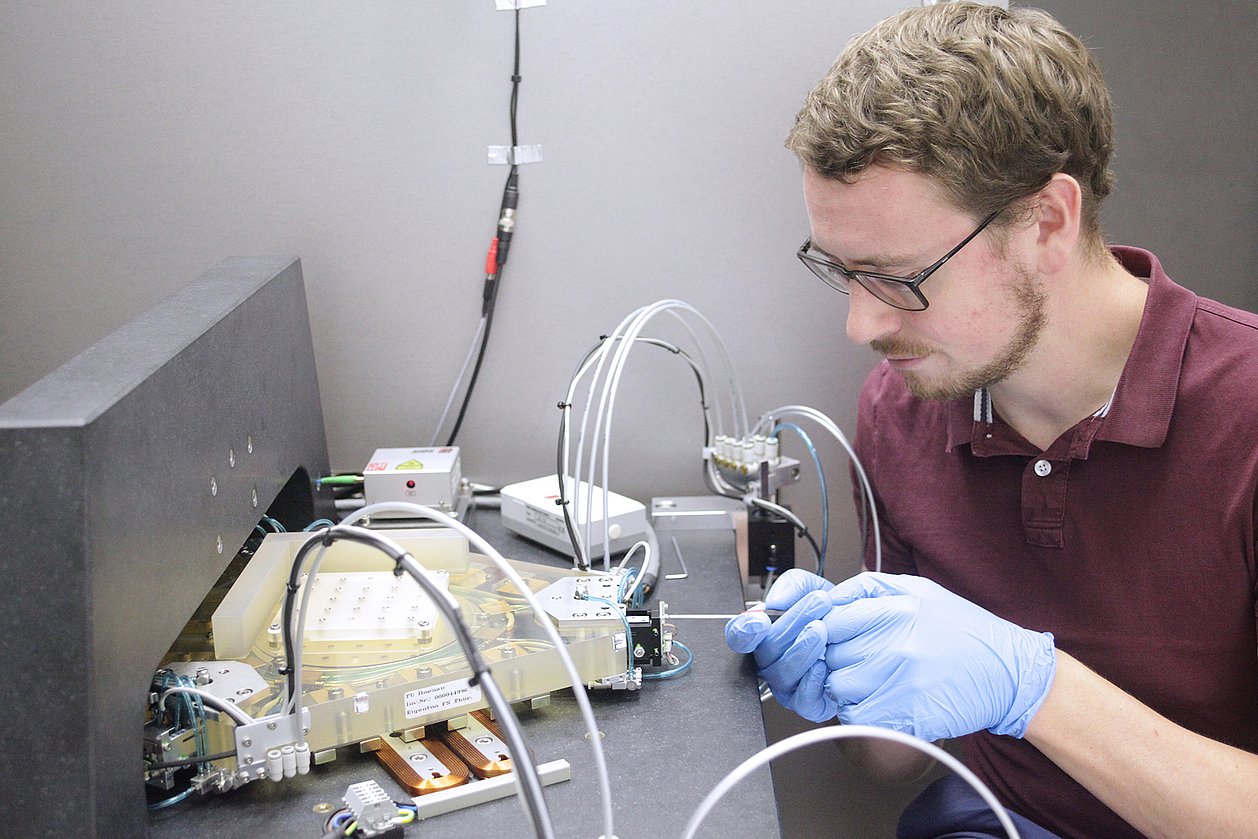
Development of mechatronic systems
We develop actuator systems and open- and closed-loop controls as embedded solutions according to customer specifications with highest demands on precision, dynamics, available space, performance and efficiency.

Service for R&D
Finite Element Modeling
We support you in the concept and development phase of new products with calculations and simulations to shorten development times and improve product parameters such as weight & material savings or minimisation of natural vibrations.
Research field
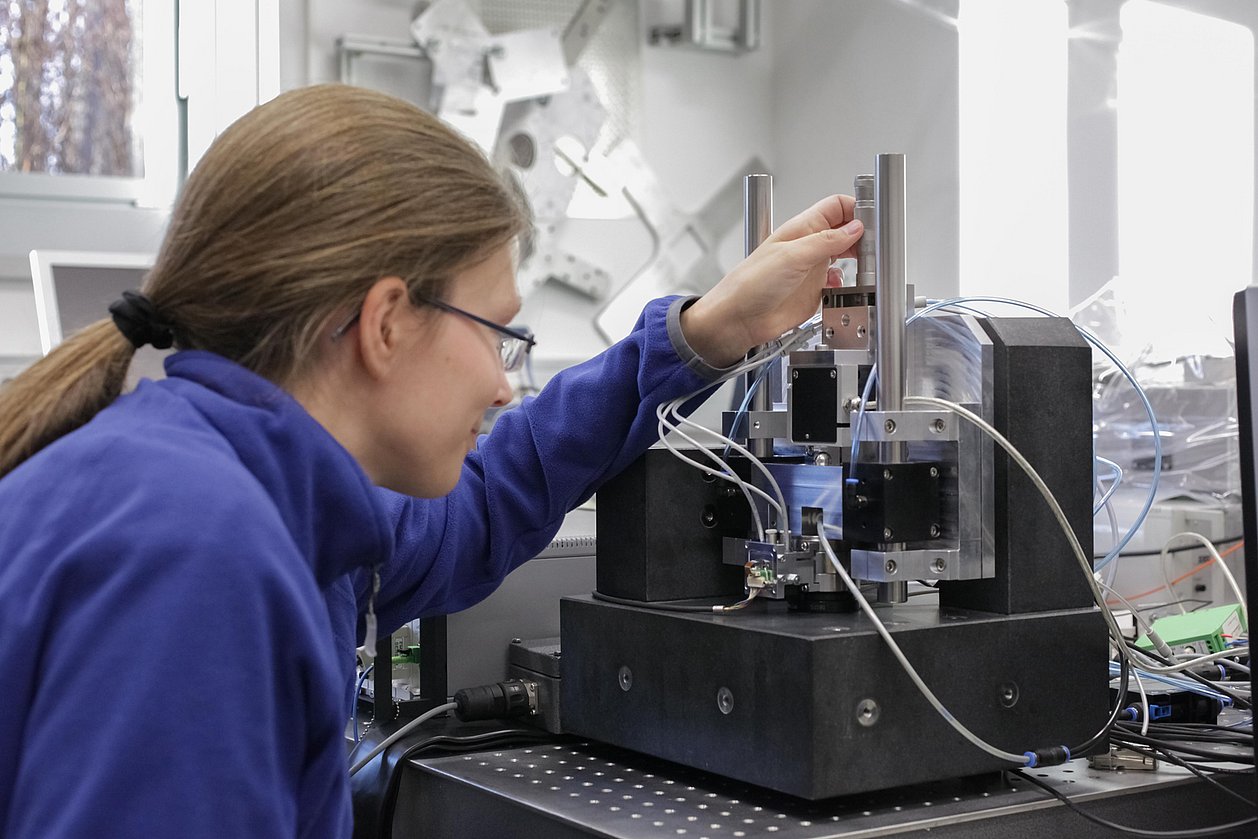
Magnetic 6D direct drives with nm precision
To enable the manufacturing of macroscopic high-tech products with microscopic precision, we are researching scientific principles and technical solutions for nanopositioning systems for large motion ranges.
Lead application
nm measurement and structuring of objects
To be able to manufacture the ever-increasing complexity of integrated systems on ever-smaller semiconductor surfaces, for example, we are researching ever more precise drives for the nanometre measurement and structuring of objects.