

Project PIC-PAM
Photonic integrated circuits for quantum key distribution to protect against cyberattacks: Design of a time-tagging ASIC with a photonic integrated polarisation analysis unit
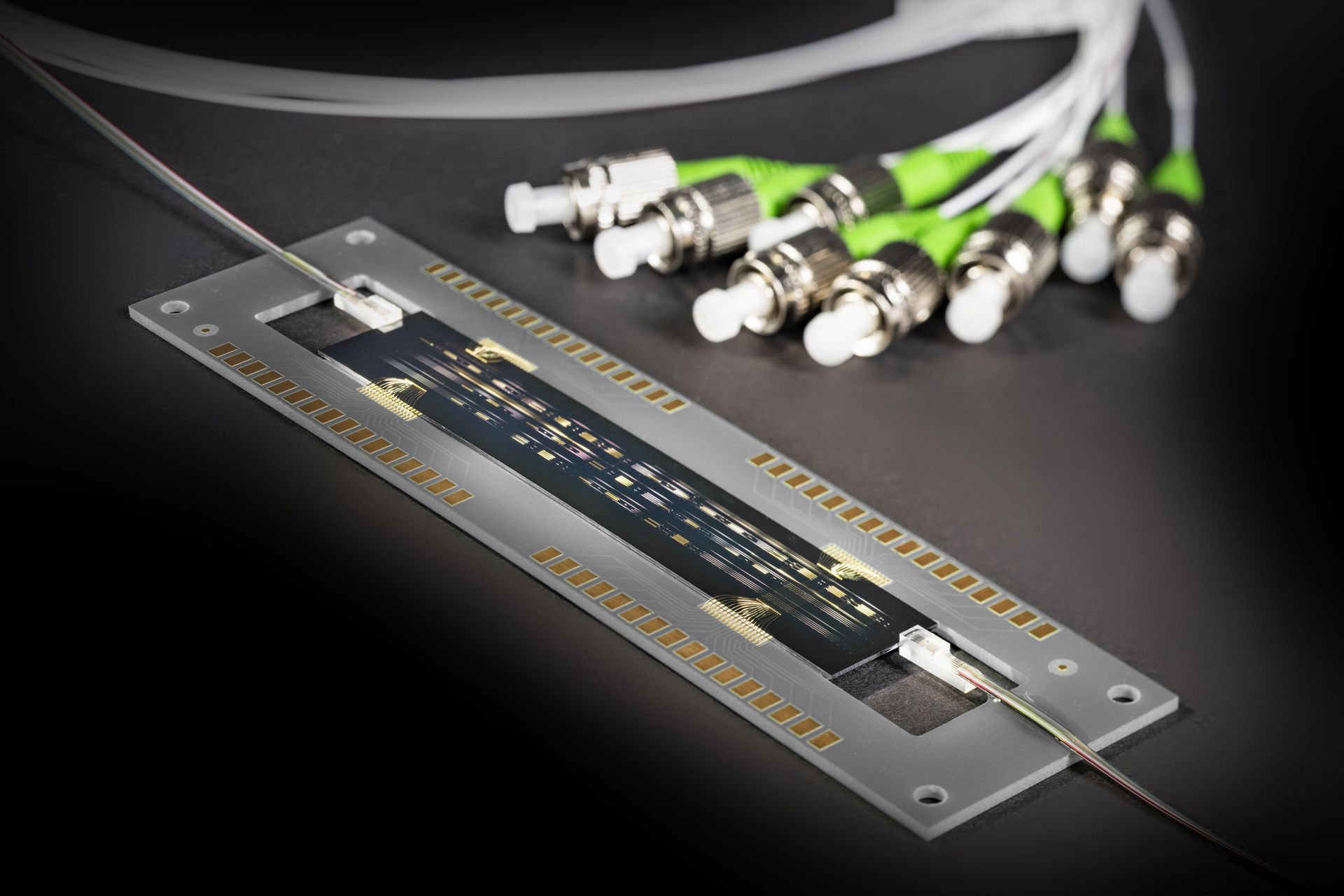
Six research and industry partners from Thüringen will closely integrate their competences in optics and photonics with those in microelectronics and sensor technology. The aim is to achieve a significant innovation breakthrough by combining integrated photonics and quantum communications to enhance the cybersecurity of German ICT fibre networks, particularly for data centres and campus networks. Therefore, small modules suitable for common network hardware at reduced costs are being targeted, which can easily be installed at security-critical locations. For this purpose, photonic and microelectronic functions will be integrated on a single silicon chip: a polarisation analysis module for measuring the quantum states of photons, single-photon detectors for highly sensitive signal conversion, and electronics for high-resolution time stamping and evaluation of the detections.
Cybersecurity for future communications infrastructures
Even today, protecting sensitive information from cyber threats is a top priority and requires ever newer and more robust security measures to ensure confidentiality and prevent unauthorised access. Quantum computers will be able to break traditional encryption methods in the coming years, thereby jeopardising the security of information. Quantum key distribution based on entanglement is considered a promising technology for securing future communications infrastructures. It is possible to generate and distribute cryptographic keys with physically guaranteed security, regardless of an attacker’s computing power. In quantum communications, it is not electrical signals but photons – individual particles of light – that are transmitted, and these are entangled in their quantum states. Information is encoded via the polarisation of a single photon. Eavesdropping, like any other form of manipulation, alters the state of the photons. This makes attacks detectable and enables targeted protective measures. For quantum key distribution three components are required: polarisation analysis to detect the state of a photon, single-photon detectors to ensure that the individual light particles are actually measured, and time stamping to synchronise the transmitter and receiver and filter out noise.
Quantum key distribution – so far, large hardware for tiny photons
To put all these theoretical advantages of quantum key distribution into practice for widespread use in the IT networks of the future, the project partners are working on a miniaturised technology platform. Current laboratory setups for quantum communications are built with a multitude of opto-mechanical components. So miniaturisation and photonic integration of quantum key distribution presents significant challenges, but also opportunities: Thüringen has expertise built up over many years in both optics and photonics on the one hand, and microelectronics and sensor technology on the other. The aim is a highly integrated solution that can be easily and flexibly deployed in network devices, much like a small SFP module. To this end, all partners will contribute to the development of more compact, standardised and industry-ready components. The challenges for assembly and interconnection technology lie in the photonic and electrical connection to the overall system.
Silicon chip will combine all functions within a few millimetres
In this project, a complete analysis unit will be developed as a monolithic integrated circuit that combines the photonic and electronic functional units on a single chip with a size of just a few millimetres. X-FAB will further develop its technologies specifically for quantum key distribution and continue to adapt CMOS processes for the manufacture of photonic-integrated chips. This would enable photonic and electronic component layers to be processed on a single wafer in future. IMMS and Fraunhofer IOF will use this X-FAB technology platform to develop subsystems for the joint chip. Fraunhofer IOF will implement all solutions for the silicon-nitride-based photonic components of the chip, such as the micro-optical assemblies, the light processing in the polarisation analysis unit including the beam splitter, and the couplers for connecting the photonic and electronic circuits and for fibre coupling from the chip to external devices. The test setups for characterising all photonic modules will be implemented at University of Jena.
IMMS to develop all electronic functional units and new timestamp electronics
Here, as many functions as possible will be integrated into the electronic layer of the chip to miniaturise the many individual components used today. One focus will be on SPAD-based single-photon detectors, which, like the existing discrete sensors, handle the highly sensitive signal conversion but will be located directly in the chip. These highly sensitive single-photon avalanche photodiodes (SPADs) will, for the first time, be expanded to include the timestamping electronics to be newly developed in PIC-PAM. This includes adapting the existing SPAD-based solutions developed by IMMS for use in quantum applications involving integrated photonics in collaboration with Fraunhofer IOF.
Small module for easy use in network devices
To ensure that these innovative chips can be used in a small, SFP-like module within network devices, AIM Micro Systems will implement the necessary assembly and interconnection technology: AIM will assemble the chips, fit them with housings and implement suitable connections for optical and electronic components, taking into account industrial suitability and manufacturing technologies. At Quantum Optics Jena, work will be done to create a photon source that enables quantum key distribution to be carried out using photons visible to SPADs. In addition, the company will build the overall demonstrator for the project based on the developments made by all partners to demonstrate the functionality of the results.
Acronym / Name:
PIC-PAM / Photonically Integrated Polarisation Analysis Module with Single-Photon Processing | Design of a time-tagging ASIC with a photonic integrated polarisation analysis unitDuration:2026 – 2029
Application:
|Cybersicherheit| Sicherheitsinfrastruktur| IKT-Fasernetze| Rechenzentren| Campus-NetzwerkeResearch field:Integrated sensor systems
Related content
Press release,
Quantum key distribution with photonic integrated circuits to protect against cyberattacks
Six research and industry partners from Thüringen launch the PIC-PAM project
Contact

Contact
Eric Schäfer, M. Sc.
Head of Microelectronics and Branch Office Erfurt, Authorised Signatory
eric.schaefer(at)imms.de+49 (0) 361 663 25 35
Eric Schäfer and his team research Integrated sensor systems, especially CMOS-based biosensors, ULP sensor systems and AI-based design and test automation. The results are being incorporated into research on the lead applications Sensor systems for in-vitro diagnostics and RFID sensor technology. It will assist you with services for the development of Integrated circuits and with IC design methods.

Funding
The joint project “Photonically Integrated Polarisation Analysis Module with Single-Photon Processing“ (PIC-PAM) is supported by the funding programme of Thüringen for the promotion of research, technology and innovation (RTI) as the research and development initiative Thüringen Verbund and co-financed by the European Union under the reference 1006811, the IMMS topic „Design of a time-tagging ASIC with a photonic integrated polarisation analysis unit“ under the reference 2026 VFE 0051.
This might also be interesting for you

Service for R&D
IC design methods
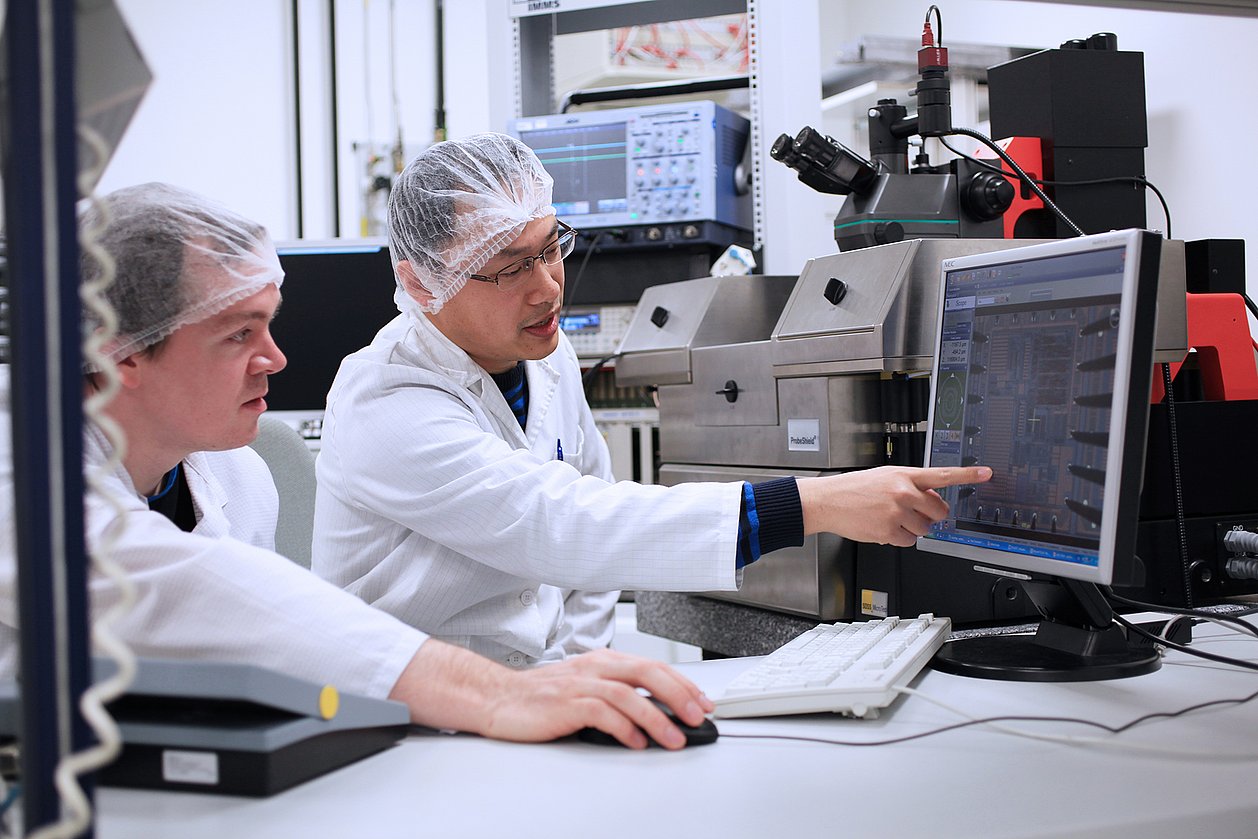
We develop new AI-based methods and tools for your system-on-chip and FPGA designs to master the increasing complexity of integrated systems and thus further increase performance.
Service for R&D
Integrated Circuits
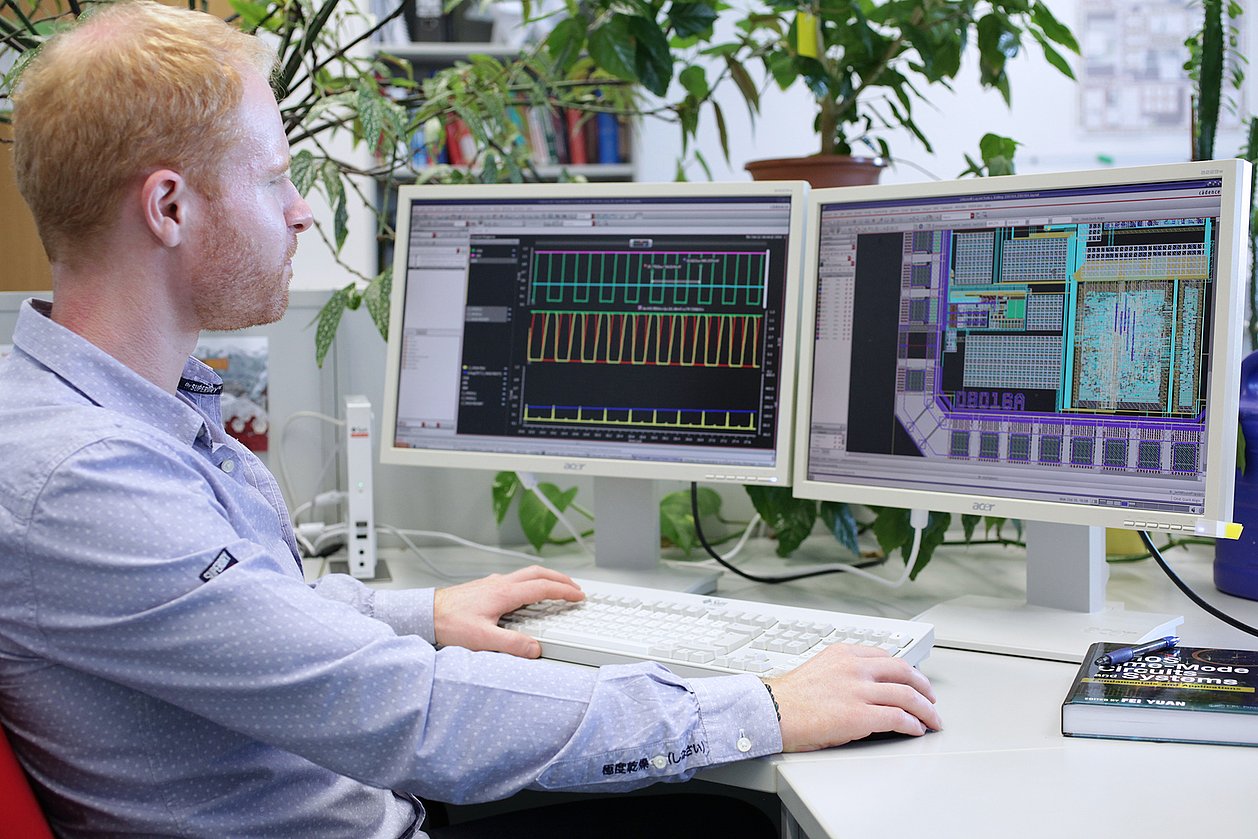
We offer the design and realisation of application-specific integrated circuits (ASICs) in CMOS, BiCMOS and SOI technologies. We achieve well-performing ASICs with our first runs (first-time right silicon).
Research field
Integrated sensor systems
Here we investigate miniaturised systems manufactured in semiconductor technology consisting of microelectronic components for sensors applications, as well as methods to design these highly complex systems efficiently and safely.
![[Translate to English:]](/fileadmin/_processed_/a/7/csm_20130223_dcSen_ProberEF_MM_MG_3325_1920x1280_588e478d86.jpg "[Translate to English:]")
Service for R&D
Test and characterisation
We test, characterise and qualify your circuits, sensors and systems. Based on our excellent pool of measurement equipment, we develop an individually adapted test environment for measurements on wafers and individual components.